

Late at night, you might hear DNA Meaning mentioned in a crime show, a medical report, or even a family conversation about health. Although the word sounds highly scientific, the DNA meaning is directly connected to who you are. In fact, DNA explains why you look the way you do, how your body works, and even why certain health conditions run in families.
However, many people still feel confused because DNA is often explained using complex scientific language. That confusion is exactly why so many people search for “DNA meaning” — they want a clear, simple explanation without jargon. This guide breaks DNA down into plain English, real-life examples, and easy comparisons so you can understand it instantly.
Find Your Age - In Years, Months, Days, Hours, Minutes, and Seconds!
Best What Does DNA Meaning Really Explain? 2026
 Please share this article with your friends ❤️


DNA means Deoxyribonucleic Acid.
It is the molecule that carries genetic instructions in all living organisms.
In simple terms, DNA works like a master instruction manual inside your body. Every cell contains DNA, and that DNA tells the cell how to grow, function, and repair itself. Without DNA, life as we know it would not exist.
Because DNA exists inside almost every cell, it quietly controls countless processes — from eye color to how your immune system responds to illness. As a result, scientists consider DNA the foundation of biology and medicine.
Most importantly, DNA is not random. Instead, it follows a precise structure that allows information to pass from parents to children. This is why family traits repeat across generations.
👉 Direct answer:
DNA is the molecule that stores and transmits genetic information in living beings.
Best What Is DNA Made Of — And Why It Matters for Your Body 2026
Please share this article with your friends ❤️
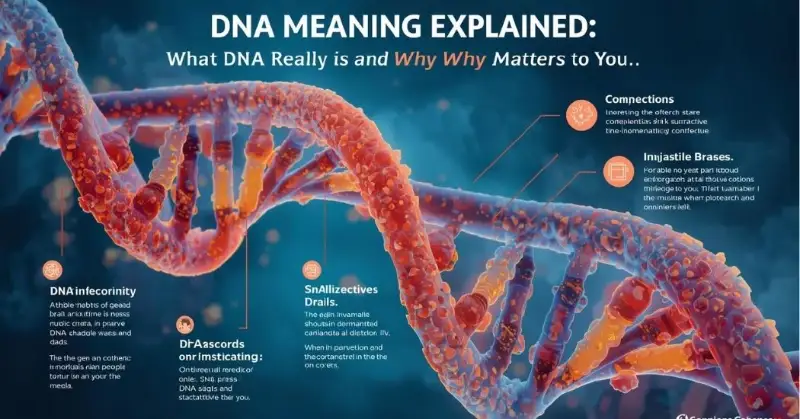
DNA has a unique double-helix shape that looks like a twisted ladder. This structure allows it to store massive amounts of information in a very small space.
Each strand of DNA contains four chemical bases:
- Adenine (A)
- Thymine (T)
- Cytosine (C)
- Guanine (G)
These bases pair together in a specific way, which helps DNA copy itself accurately. Because of this, your cells can divide and repair damage without losing important information.
More importantly, the order of these bases determines your genetic traits. Even a tiny change in this sequence can affect how your body functions. Therefore, DNA plays a direct role in health, development, and disease prevention.
Best DNA Meaning in Biology vs Everyday Language 2026
Please share this article with your friends ❤️
In biology, DNA refers to the physical molecule found inside cells. Scientists study it to understand genetics, evolution, and medical conditions.
However, in everyday language, people often use DNA as a metaphor. For example, someone might say, “Music is in his DNA.” In this case, they do not mean actual genetics. Instead, they mean the trait feels natural or deeply rooted.
Because of this dual usage, confusion often arises. While scientists use DNA literally, casual conversations use it symbolically.
👉 Key difference:
Biology = physical molecule
Everyday speech = deeply ingrained trait
Best DNA vs Genes vs Chromosomes (Simple Explanation) 2026
Please share this article with your friends ❤️
A major reason people search DNA meaning is confusion between DNA, genes, and chromosomes. Although these terms relate closely, they do not mean the same thing.
DNA vs Genes
DNA acts as the full instruction manual. Within that manual, genes represent specific instructions that control traits like hair color, height, or blood type.
DNA vs Chromosomes
Chromosomes are organized bundles of DNA found inside the cell nucleus. Humans usually have 23 pairs of chromosomes, each containing long strands of DNA.
👉 Simply put:
DNA contains genes, and chromosomes package DNA neatly.
Best Why DNA Is More Than Just Science — It’s About You 2026
Please share this article with your friends ❤️
DNA does not stay locked in laboratories. Instead, it affects everyday life in powerful ways.
For example, doctors use DNA to:
- Detect inherited diseases
- Personalize treatments
- Understand cancer behavior
Meanwhile, ancestry tests analyze DNA to show family origins and genetic connections. As a result, DNA has become part of modern healthcare and identity exploration.
Even law enforcement relies on DNA to solve crimes. Because DNA is unique to each person, it acts like a biological fingerprint.
Best DNA Meaning in Medical Reports and Health Tests 2026
Please share this article with your friends ❤️
When DNA appears in medical reports, it usually relates to genetic testing. Doctors analyze DNA to detect mutations or inherited conditions.
For instance, DNA testing can:
- Identify risk for certain diseases
- Guide medication choices
- Confirm genetic disorders
However, seeing DNA mentioned in a report does not always mean something is wrong. Often, doctors use DNA simply to rule out possibilities.
👉 Important:
DNA testing provides information — not automatic diagnoses.
Best Can DNA Change Over Time? 2026
Please share this article with your friends ❤️
Your core DNA remains mostly stable throughout life. However, small changes called mutations can occur due to aging, environment, or radiation exposure.
Sometimes these changes cause health problems. Other times, they have no noticeable effect. In rare cases, mutations even help humans adapt over generations.
Therefore, while DNA stays consistent, it is not completely unchangeable.
Best Common Misunderstandings About DNA Meaning 2026
Please share this article with your friends ❤️
Many people believe DNA determines everything about a person. In reality, DNA provides instructions, but environment and lifestyle also play major roles.
Another misconception is that DNA is only important for scientists. In truth, DNA influences health, behavior, and family history for everyone.
Finally, some assume DNA tests reveal destiny. However, they only show probabilities, not certainties.
FAQ Section
Please share this article with your friends ❤️
What does DNA mean?
DNA stands for Deoxyribonucleic Acid. It is the molecule that carries genetic information and instructions for how living organisms grow and function.
What does DNA stand for in simple words?
In simple terms, DNA is the instruction code of life that tells your body how to develop and work.
What is DNA used for?
DNA is used to pass traits from parents to children, study health conditions, identify individuals, and understand ancestry.
Is DNA the same as genes?
No. DNA is the complete genetic material, while genes are small sections of DNA that control specific traits.
Can DNA change over time?
DNA mostly stays the same, but small changes can happen due to aging, environment, or exposure to certain chemicals.
Best Final Meaning of DNA (Simple Summary) 2026
Please share this article with your friends ❤️
DNA Meaning Deoxyribonucleic Acid — the molecule that carries genetic instructions in living organisms. It stores information, passes traits between generations, and guides how the body works.
Although the word sounds technical, DNA is deeply personal. It connects your past, shapes your present, and influences your future.
Understanding DNA meaning helps you better understand yourself.
Late at night, you might see DNA mentioned in a crime show, a medical report, or a science post online — and suddenly wonder what it actually means.
